causal-falsify: Causal falsification algorithms in Python


A Python library with multiple algorithms for falsifying the unconfoundedness assumption in multi-environment (or, multi-source) datasets. Source code: https://github.com/RickardKarl/causal-falsify
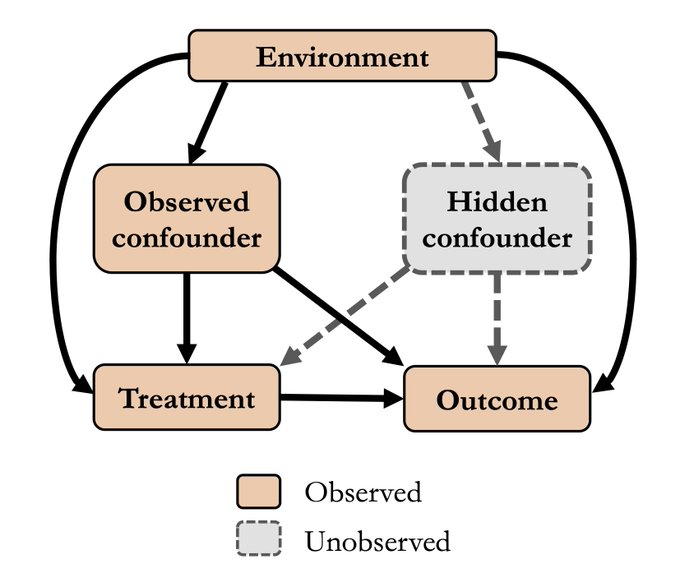
Here is an example causal directed acyclic graph where these algorithms can be applicable:
Installation
Install from PyPI:
pip install causal-falsify
Example Usage
Below is an example using the MINT algorithm. When calling MINT().test(...), it returns a p-value that can be interpreted as a statistical test of the joint null hypothesis: that unconfoundedness holds and the causal mechanisms are independent. A sufficiently small p-value indicates rejection of this null, suggesting that hidden confounding may be present. Note that HGIC and the transportability test have their corresponding classes HGIC and TransportabilityTest with the same test(...) function.
from causal_falsify.algorithms.mint import MINT
from causal_falsify.utils.simulate_data import simulate_data

# Generate a pd.DataFrame with synthetic data containing columns [X_0, X_1, S, A, Y]
confounded_data = simulate_data(
    n_samples=250,
    conf_strength=1.0,
    n_envs=10,
    n_observed_confounders=2
)

# Initialize falsification algorithm and run it on the data
mint_algorithm = MINT(binary_treatment=False, binary_outcome=True)
p_value = mint_algorithm.test(
    confounded_data,
    covariate_vars=["X_0", "X_1"],
    treatment_var="A",
    outcome_var="Y",
    source_var="S",
)

# A small p-value would imply that hidden confounding may be present
print("p-value:", p_value)
print("reject null of no hidden confounding at sign. level 5%:", p_value < 0.05)